

That leftover can of exterior paint sitting in the garage can be tempting. Can you use exterior paint inside to finish a room without making another trip to the store? It is a fair question, one that homeowners across The Villages ask more often than you would think.
If you are asking can I use exterior paint inside, the honest answer, for your health, your walls, and your wallet, is no. Here is exactly why that matters, and what to do if you have already made the switch by accident.
Key Takeaways
- Exterior paint carries much higher levels of volatile organic compounds (VOCs) than interior paint.
- According to the EPA, everyday indoor VOC levels run 2 to 5 times higher than outdoors, and short-term spikes during activities like paint stripping can reach up to 1,000 times outdoor levels.
- Symptoms from VOC exposure range from headaches and dizziness to long-term respiratory and organ damage.
- Children, pets, and people with asthma or allergies face the greatest risk.
- Exterior paint also performs worse on interior surfaces, since it can peel, look uneven, and be harder to clean.
- If exterior paint was already applied indoors, priming and repainting with the right interior product is the correct fix.
What Makes Exterior Paint Different From Interior Paint
Exterior and interior paints are not the same product in different packaging. They are built for completely different jobs.
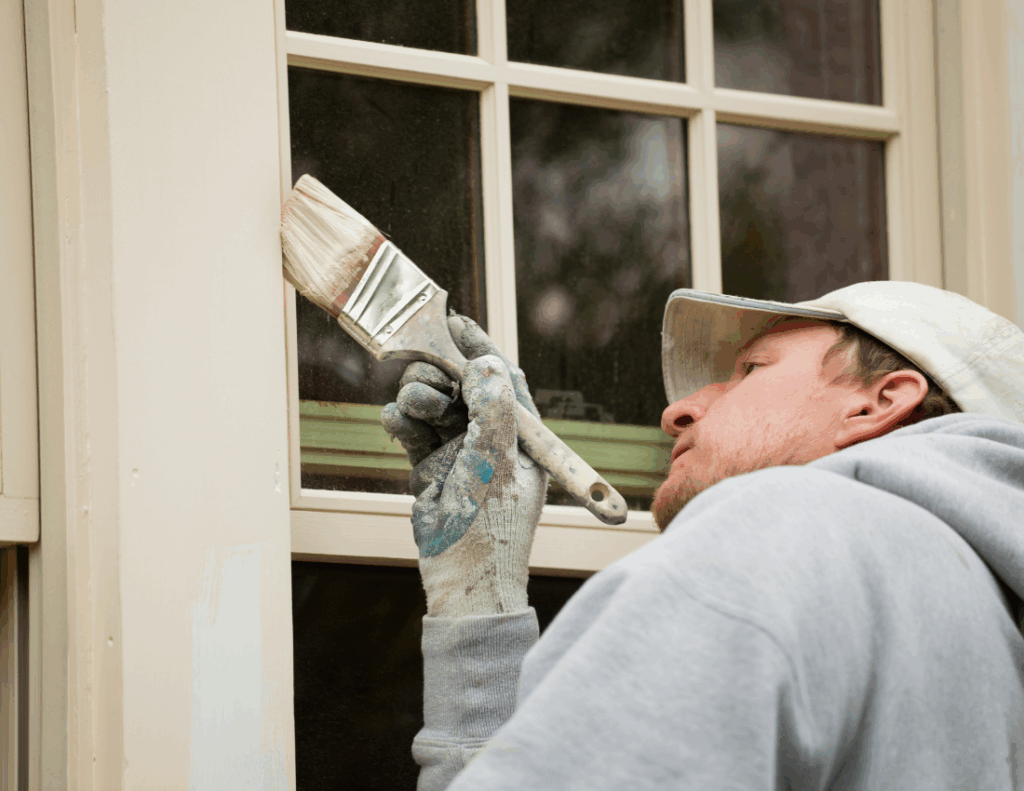
Exterior paint is formulated to handle rain, UV rays, temperature swings, and humidity. Here in The Villages, that means standing up to Florida’s intense afternoon sun, punishing summer storms, and heat that settles in for months. To survive that, it resists mildew and temperature fluctuations with a durable resin that fights chipping, peeling, and fading better than interior resins, the same toughness that matters when you paint exterior window trim.
Exterior paints also carry higher levels of VOCs and extra chemical additives to withstand outdoor conditions. Those additives, the mildewcides, fungicides, and UV-blocking agents, are what make exterior paint resilient outside, and they are also what make it a problem indoors.
Interior paint uses different resins that look flat, even, and smooth on the wall, built to be washable and scratch-resistant for the demands of a busy home. Two different formulas for two different environments, so swapping one for the other is not just a matter of preference, and a quick look at a guide to different paint sheens shows how much the finish itself matters.
Can I Use Exterior Paint Inside? What the Health Risk Looks Like
When you ask can I use exterior paint inside, the air in the room is the first reason to stop. Applied indoors, exterior paint has no open air to disperse the chemicals it releases, so in a closed room, a bedroom, a living room, a Florida retirement home, those chemicals stay right where you are.
Indoor VOC levels typically run 2 to 5 times higher than outdoors, and short-term spikes during activities like paint stripping can climb far higher still. Exterior paint adds to that load because it is formulated with more VOCs than interior paint, chemicals designed to off-gas into open air, not a sealed room.
Indoors, these chemicals can off-gas into the air and cause poor indoor air quality, irritation of the eyes, nose, and throat, headaches, and potential long-term respiratory issues. They do not simply vanish once the paint dries either, since VOCs and additives can keep off-gassing for weeks or even years in poorly ventilated spaces.
Prolonged exposure has been linked to central nervous system damage and, in some cases, increased cancer risk, and children, pets, and people with respiratory conditions are especially vulnerable. For residents in The Villages, many of whom spend more time at home and may have existing health considerations, that is not a minor inconvenience.
The mildew-fighting ingredients in exterior paint can also cause odors and allergic reactions in confined areas. That fresh-paint smell you notice after a coated room can drag on for weeks instead of days with exterior paint. For a deeper look at how VOCs affect the air in your home, the EPA’s resource on volatile organic compounds and indoor air quality lays out the full picture.
Why Exterior Paint Underperforms on Interior Walls
Health is the biggest reason can I use exterior paint inside gets a firm no, but exterior paint also simply does not hold up on interior surfaces the way interior paint does.
Most exterior paints are made to grip siding, stone, and brick, while interior paint binds to drywall. Apply exterior paint to drywall and it may not adhere properly, so you can see more deterioration, cracking, and chipping than you would with an interior product, the kind of problem our guide on how to repair chipped paint walks through.
There is also a cost problem. Exterior paints cost more than interior ones because of their chemical additives and heavy-duty makeup, so paying extra for weather resistance and UV protection buys you nothing useful on a living room wall.
If you are choosing products for rooms with moisture concerns, where exterior paint might seem appealing, our post on best paint for bathroom walls and ceiling covers what actually works in those conditions.
What If You Already Used Exterior Paint Inside?
Accidents happen. Maybe a helper grabbed the wrong can, or two containers looked identical after a busy weekend. At that point the question is no longer can I use exterior paint inside, but how to undo it, and if exterior paint has already gone on an interior wall, here is what to do.
- Ventilate immediately. Open every window and run fans to move air outside. Ventilation reduces immediate exposure to fumes, and while it does not eliminate the health risk, it is still the right first step.
- Keep children and pets out of the room. Limit time in the painted area until the paint has fully cured and ventilation has had time to work.
- Let it dry completely. Do not try to paint over wet exterior paint, and follow the full drying time listed on the product label.
- Apply a quality interior primer. Once the exterior paint is fully dry, a high-quality indoor primer seals it and helps stop odors and chemicals from spreading through the home. Our post on why primer matters before any paint goes on covers how to choose the right product.
- Repaint with interior paint. Finish with a low-VOC interior paint suited to the room, which restores your air quality and gives you a surface that actually performs indoors.
What the Right Interior Paint Actually Does for Your Home
A good interior paint, matched to the room, the surface, and the finish, does things exterior paint cannot replicate. It cures to a smooth, even surface that cleans up easily, resists scuffs and staining, and holds color without the heavy chemical load exterior paint relies on. And it does all of that without filling your home with compounds that take weeks or months to dissipate.
In The Villages, where homes often move on the market and resale value matters, interior paint choices also shape what buyers see and how a home feels. The right colors and finishes make a real difference, and our post on best interior paint colors for resale value covers what actually moves the needle for buyers.
If you are unsure which sheen makes sense for different rooms, understanding the difference between eggshell versus semi-gloss paint can save you from a costly repaint down the road.
The Straight Answer
Can I use exterior paint inside? The answer is not just no because that is the rule. It is no because of what it actually does, to the air in your home, to the surfaces you paint, and to the people living there. The chemicals that make exterior paint tough outdoors are the same ones that make it a poor and potentially harmful choice indoors.
The right paint for the right surface is not just a contractor preference. It is the difference between a room that performs the way it should and one that costs more, looks worse, and brings health risks that linger long after the brush dries.
If you have an interior project coming up in The Villages, or you are dealing with the aftermath of the wrong paint on the wrong surface, Premium Painting is ready to help. Our 3 to 4 painter crews handle interior jobs with care that lasts, and every project is backed by a 7-year labor warranty. Call 352-660-7820 for a FREE estimate today.